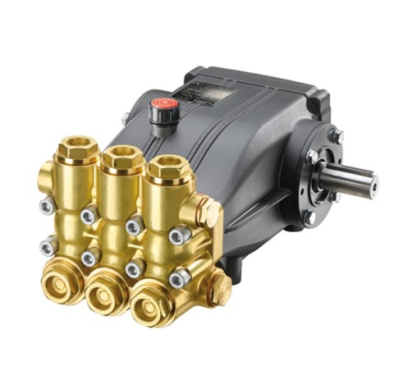
Hawk's ATEX-certified pumps
In many industrial environments, from refineries to chemical plants, through to tanks and stores of flammable substances, the presence of combustible gases, vapours, mists or dusts makes the atmosphere potentially explosive. In these settings, using a "standard" high-pressure pump is not merely inadvisable: it is prohibited by European legislation. Every mechanical and electrical component must be designed, certified and marked in compliance with the ATEX Directive. In this article we look at what ATEX-certified pumps are, when they are mandatory and what defines Hawk's XLTI ATEX series, the solution developed for high-pressure cleaning systems intended for areas classified as explosion-risk zones.
What ATEX pumps are
The term ATEX derives from the French "ATmosphères EXplosibles" and identifies European Directive 2014/34/EU, which replaced the previous 94/9/EC and became fully applicable on 20 April 2016. The directive governs the design, manufacture and placing on the market of equipment and protective systems intended for use in potentially explosive atmospheres, that is, in all those environments where flammable mixtures of air with gases, vapours, mists or dusts may form.
An ATEX pump is therefore a pump designed, tested and certified not to act as a source of ignition in these atmospheres. All components, materials, couplings, seals and rotating parts, are engineered to prevent sparks, overheating or build-ups of electrostatic charge that could trigger an explosion.
To be placed on the European market, an ATEX pump must bear the CE marking accompanied by the Ex symbol and the specific marking string (group, category, type of atmosphere, temperature class). Without this certification, it cannot be used in any classified area.
When an ATEX pump is mandatory
The obligation arises the moment a workplace is classified as an "ATEX zone". The legislation distinguishes between:
- Gas, vapour or mist zones: zone 0 (present continuously or for long periods), zone 1 (likely to be present in normal operation), zone 2 (unlikely to be present or present only for a short time).
- Combustible dust zones: zones 20, 21 and 22, following analogous logic.
The sectors in which ATEX classification is part of everyday operations include the oil sector, petrochemicals, the chemical and pharmaceutical sector, the food industry where dusts are present (sugars, flours), paint and coating plants, refineries, and fuel and biofuel depots. In all these environments, every piece of equipment introduced into the classified area, including pumps for washing, degreasing, tank cleaning and maintenance, must comply with the ATEX Directive.
Hawk's XLTI ATEX series: overview
Within its range of high-pressure piston pumps, Hawk has developed a version specifically for classified areas: the XLTI ATEX series, also identified by the designation XLTI-EX. It is a variant of the well-established XLTI platform, redesigned for safe installation on cleaning systems operating in hazardous and potentially explosive environments.
The XLTI-EX pumps are positive-displacement piston pumps capable of working at a maximum pressure of 300 bar with a water temperature of up to 65 °C (149 °F). They carry a specific certification attesting to their suitability for use in classified zones, making them a natural choice for manufacturers of pressure washers, fixed industrial cleaning plants and mobile units intended for maintenance work in refineries and chemical facilities.
Full constructional details are available on the XLTI ATEX series product page.
Key technical features of the XLTI ATEX
The table below summarises the key features of the XLTI-EX series as confirmed by Hawk, to guide the selection process during plant design.
|
Feature |
Value / description |
|
Type |
High-pressure positive-displacement piston pump |
|
Maximum operating pressure |
300 bar |
|
Maximum water temperature |
65 °C (149 °F) |
|
Certification |
Specific ATEX certification for potentially explosive environments |
|
Intended use |
Cleaning systems in areas classified as explosion-risk zones |
|
Product family |
Hawk XLTI platform |
This combination of high pressure and suitability for use in explosive atmospheres is what sets the XLTI-EX apart from the standard versions of the same family: the mechanical base is that of a proven high-pressure pump, but every aspect critical from an ATEX standpoint is managed to ensure compliance with Directive 2014/34/EU.
Typical applications of the XLTI ATEX
The XLTI-EX pumps are used wherever high-pressure cleaning has to be combined with safety in an explosive atmosphere. The most frequent applications include:
- cleaning tanks, vessels and silos that have held hydrocarbons, solvents, oils or flammable chemical substances;
- maintenance of plant and pipework in refineries, coastal depots and storage terminals;
- washing of process equipment in the chemical and petrochemical industry;
- degreasing and cleaning of components in facilities where flammable dusts or vapours are present.
In all these scenarios, the pump is the heart of a machine or complete plant, which in turn must be designed and certified as an ATEX assembly. The availability of a pump that is already compliant considerably simplifies the design and final certification of the system.
The advantages of choosing a Hawk ATEX pump
Choosing an ATEX-certified pump is not merely a formal step: it is a decision that affects the safety of people, production continuity and the validity of industrial insurance cover. Opting for a Hawk XLTI ATEX pump means starting from a component designed specifically for explosion risk, built into a proven platform and backed by an Italian manufacturer, Leuco S.p.A., owner of the Hawk brand, with more than three decades of experience in high-pressure piston pumps.
For manufacturers of pressure washers and cleaning systems, this is the starting point for building machines that are certifiable and immediately marketable to customers operating in classified areas. For end users, it is the assurance of working with a pump designed from the outset for the context in which it will be used, with no compromise on operating pressure or long-term reliability.
Share this Article