Guide to selecting high-pressure pumps for ceramic facilities
In ceramic plants temperature management is a critical factor: the tile firing kilns operate at extremely high temperatures and generate significant thermal loads that must be controlled to ensure product quality, process stability and adequate working conditions. In this context, high-pressure pumps play a central role, especially when they feed a misting system used to homogenize and control the temperature. This guide explains how misting works when applied to the ceramic sector, what characteristics a pump for these plants must have and which Hawk solutions are best suited, starting with the FOG series. The goal is to answer one question clearly: which high-pressure pumps are used in ceramic plants.
Misting for temperature homogenization in the kilns
The principle behind high-pressure misting applied to the firing kiln area of a ceramic plant makes it possible to control and even out the temperature, reducing thermal swings and contributing to a more stable, uniform working environment. The quality of the result depends directly on the pump's ability to maintain a constant pressure: only a stable pressure ensures droplets of uniform size and therefore effective cooling. Discontinuous pressure, on the contrary, alters the droplet size and reduces the efficiency of the entire system.
In addition to cooling and thermal homogenization, in ceramic plants high-pressure piston pumps are also used in industrial cleaning operations and in dust suppression, confirming the versatility of this technology. To learn more about how these systems work and the possible configurations, it is helpful to consult the page dedicated to misting systems.
The characteristics a pump for ceramic plants must have
Not all pumps are suitable for working in a ceramic plant. The operating conditions, prolonged duty cycles, hot environments and the need for a fine, constant mist, impose precise technical requirements. High-pressure piston pumps are the go-to technology precisely because they meet these needs better than other solutions. The essential characteristics to assess are few but decisive:
- Stable, high working pressure: this is the parameter that determines how fine the droplets are; a fine mist requires high pressure held constant throughout the entire work cycle.
- Adequate flow rate: it must be sized to the number of nozzles installed and the extent of the area to be treated.
- Resistance to continuous operation and low maintenance, because these plants often run for many hours in a row.
- Compatibility with treated or demineralized water, frequently used to prevent limescale buildup in the nozzles and lines.
One last aspect concerns the fluid temperature: where process conditions require it, it is advisable to opt for versions designed to withstand higher water temperatures, available in the Hawk range in high-temperature configurations as well.
The FOG series: the compact solution for misting
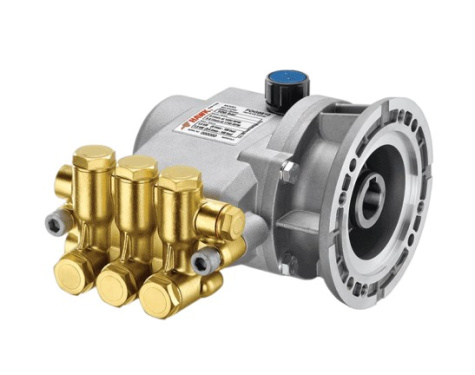
For compact misting systems with limited flow rates, the go-to Hawk solution is the FOG series. These are piston pumps able to work at a maximum pressure of 100 bar and with a water temperature up to 65°C (150°F), with a compact design that makes them particularly suitable for mounting on small misting systems. Precisely these features, pressure sufficient to produce a fine mist, small size and reliability under repeated operation, make the FOG series the ideal basis for misting systems dedicated to temperature control. Full specifications are available on the FOG series page.
When the plant grows in size, the number of nozzles increases or the area to be cooled expands, a pump with a higher flow rate is needed instead. In this case the Hawk range offers piston series with higher performance, suitable for large misting systems as well.
The Hawk solutions compared
The following table compares the main Hawk series that can be used for misting in ceramic plants, according to pressure, flow rate and plant size. The choice essentially depends on the number of nozzles and the extent of the area to be treated.
|
Series |
Maximum pressure |
Maximum flow rate |
Water temperature |
Typical use |
|
FOG |
100 bar |
Limited flow rates |
Up to 65°C |
Small, compact misting systems. |
|
MXT |
200 bar |
Up to 100 l/min |
Up to 65°C |
Extended misting systems, with multiple nozzles. |
|
HFR |
280 bar |
Up to 120 l/min |
Up to 65°C |
Large plants requiring a high flow rate. |
|
NMT |
350 bar |
Up to 150 l/min |
Up to 65°C |
Professional misting systems of medium and large size, with high flow demand. |
How to choose the right pump
Choosing the pump for a ceramic plant follows a precise logic. The first criterion is the flow rate, which should be calculated from the number and type of nozzles and the size of the area to be cooled: more nozzles and larger surfaces require higher flow rates. The second criterion is the pressure, which must be sufficient to produce fine droplets and, above all, must be able to be held stable over time; choosing a pump with a maximum pressure well above the working pressure is the best way to ensure reliability and long service life. The third criterion is water quality: with hard water it is advisable to plan for treatment and demineralized water to protect nozzles and lines from limescale deposits.
Finally, the general rule that applies to all misting systems holds true here: the pump is the heart of the system, but the final result depends on the consistency between the pump, the pressure regulating valves with by-pass and the calibrated nozzles. It is the combination of these components that determines the quality of the misting and the energy efficiency of the plant.
Which high-pressure pumps are used in ceramic plants
In short, the pumps used in ceramic plants are high-pressure piston pumps intended to feed misting systems for temperature homogenization and control, as well as for cleaning and dust suppression. For compact plants the go-to solution is the FOG series (up to 100 bar, water up to 65°C), ideal for small misting systems; when higher flow rates are needed, you move to higher-performance series such as MXT (up to 200 bar and 100 l/min) and HFR (up to 280 bar and 120 l/min), while the NMT series is the reference for professional misting of medium and large size. The right choice always starts from the required flow rate and the working pressure, with an adequate margin to ensure stability and reliability over time.
Share this Article