Pressure gauges for high-pressure pumps: the Hawk guide
The pressure gauge is one of the simplest accessories to look at and one of the easiest to underestimate: yet, in a system built around a high-pressure piston pump, it is the instrument that tells you in real time whether everything is operating under the right conditions. This guide explains what a water pressure gauge is for, what the main types are (Bourdon tube, diaphragm and glycerin-filled), how to read the full-scale value, which materials to choose depending on the environment and where to correctly install the instrument on the system. The goal is to give you clear criteria to answer two practical questions: which pressure gauge is best suited to measuring water pressure on a high-pressure pump, and how to choose a pressure gauge for an industrial pump.
What a pressure gauge on the pump is for
On a high-pressure pump the pressure gauge is the primary monitoring instrument: it shows the actual working pressure and lets you check that the pump and the pressure regulating valve are operating at the value set by the system design. A stable reading that matches the nameplate data indicates correct operation; abnormal fluctuations, sudden drops or repeated spikes are often the first signs of problems such as worn seals, faulty valves, insufficient suction or the onset of cavitation.
Monitoring pressure is therefore not only a matter of performance, but also of the safety and service life of the system: running above the maximum allowable pressure overstresses components and seals, while a value that is too low signals a loss of efficiency. This is why choosing the right instrument — type, full-scale value and materials — has a direct impact on the reliability of the entire system.
The types of pressure gauge
Not all pressure gauges are the same. In piston pump applications you mainly come across three solutions, which differ in their operating principle and in the way they react to the pulsations typical of this type of pump. The choice depends on the pressure involved, the fluid being pumped and the working environment.
|
Type |
Operating principle |
Ideal use |
Practical notes |
|
Bourdon tube (dry) |
A curved metal tube deforms under pressure and moves the needle through a mechanical linkage. |
Measuring medium-to-high pressures with a stable value and no strong vibrations. |
A basic, economical solution; however, it is affected by pulsations and vibrations, which wear out the mechanism. |
|
Glycerin-filled |
The same Bourdon element is immersed in a liquid (glycerin) that dampens the movement of the needle. |
Piston pumps and systems subject to pulsations, vibrations and pressure surges. |
The reading stays steady and legible and the mechanism lasts longer: it is the go-to choice on high-pressure pumps. |
|
Diaphragm |
A diaphragm separates the fluid from the measuring element, isolating the mechanism from direct contact. |
Aggressive, dense, dirty or crystallizing fluids that would damage a traditional Bourdon gauge. |
Protects the instrument from the fluid; useful in chemical settings or with fluids that are not clean. |
Glycerin-filled or dry gauge: when each one is the better choice
The most important difference in everyday practice is the one between a dry gauge and a glycerin-filled gauge. A piston pump inherently generates pressure pulsations: on a dry gauge the needle tends to vibrate and "jump," making the reading difficult and wearing out the mechanism more quickly. The glycerin-filled gauge solves both problems, because the liquid dampens the oscillations and keeps the needle steady, while at the same time protecting the internal parts from mechanical stress. For exactly this reason, we at Hawk fit glycerin-filled gauges only, which increases both the safety and the quality of the product.
As a general rule, on high-pressure pumps with marked pulsations — which is nearly all piston pumps — a glycerin-filled gauge is preferable. The dry model remains a valid option only where the pressure is stable and free of significant vibrations, a condition that is rare in a high-pressure pumping system.
The full-scale value and the 1.5×–2× rule
The full-scale value is the maximum pressure the gauge is able to measure. Choosing it correctly is essential both for reading accuracy and for the life of the instrument. A pressure gauge works best when the working pressure falls roughly in the middle of its scale: if the full-scale value is too close to the working pressure, the instrument is constantly stressed at its limit and wears out; if it is too high, the reading becomes imprecise because the needle only moves across a small portion of the dial.
The most common rule of thumb is to size the full-scale value at between 1.5 and 2 times the pump's maximum working pressure. This way the normal working pressure sits within a reliable reading range, leaving margin to handle any spikes. A few concrete examples:
- - A pump working at around 200 bar — recommended full-scale value roughly between 300 and 400 bar.
- - A pump working at around 350 bar — recommended full-scale value roughly between 500 and 700 bar.
- - A pump working at around 500 bar — recommended full-scale value roughly between 800 and 1,000 bar.
The Hawk water pressure gauge is available with scales from 160 to 1,600 bar: a range that covers virtually every working pressure of piston pumps, making it possible to apply the 1.5×–2× rule across the entire power range of the system.
Materials: when you need stainless steel and the ATEX version
The gauge material should be chosen according to the fluid and the environment. In applications with clean water and in ordinary environments a standard gauge is enough; in more demanding settings the use of stainless steel components becomes decisive. For the food and chemical sectors, where corrosion resistance, hygiene and compatibility with detergents and aggressive agents are required, the benchmark is AISI 316, the stainless steel best suited to these conditions.
In systems operating in potentially explosive atmospheres, ATEX compliance is also required. The Hawk pressure gauge is also available in an INOX-ATEX version, making it suitable for complex, potentially explosive environments as well as for the most demanding professional applications. If you are selecting components for a system intended for the food industry, consistency of materials across the pump, valves and instrumentation is a requirement to consider from the design stage.
Where to install the pressure gauge on the system
The position of the pressure gauge is decisive for obtaining a reliable measurement of the working pressure. On high-pressure pumps, the recommended installation point is directly on the pump or in the section between the pump and the pressure regulating valve. In this position the gauge reads the pressure actually generated by the pump, before the fluid passes through piping, accessories or points of use that can introduce head losses and alter the measured value.
If the gauge is installed further downstream, in fact, the pressure read may turn out to be lower than the pressure actually developed by the pump, because it is affected by the presence of valves, filters, piping, nozzles or other components. To check the pump's performance, verify that it is working within the design parameters and correctly adjust the by-pass valve, it is therefore essential to measure the pressure at the point where it reaches its maximum value — that is, before the pressure regulating valve.
In some systems it can still be useful to install additional gauges at specific points, for example on the accumulator to check the pre-charge pressure, or downstream of the valve to monitor the pressure available at the point of use. Nevertheless, the main reference for calibration and for checking the correct operation of the pump always remains the gauge installed between the pump and the pressure regulating valve.
This section of the system is also where the pulsations typical of piston pumps occur: for this reason it is advisable to use a glycerin-filled gauge, which dampens the movement of the needle, ensures a stable reading and helps preserve the internal mechanism over time. The choice of gauge should therefore be coordinated with that of the other components on the line, starting with the pressure regulating valves.
The Hawk pressure gauge for high-pressure pumps
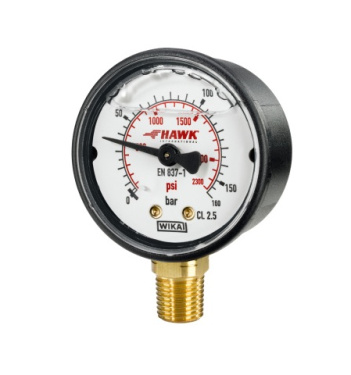
The Hawk water pressure gauge is a reliable and accurate instrument for monitoring pump pressure in high-pressure systems. It is available with a radial or axial connection and G 1/4 M or G 1/2 M threads, and it is designed to withstand pressures up to 1,600 bar (23,206 PSI). The available scales, from 160 to 1,600 bar, cover a wide range of use and adapt to many operational needs. The availability of INOX-ATEX versions makes it suitable for complex, potentially explosive environments as well, while its quality construction ensures accuracy and strength in the most demanding professional applications.
Which pressure gauge to choose, in short
To measure water pressure on a high-pressure pump, the most suitable gauge is, in the great majority of cases, a glycerin-filled gauge, with a full-scale value of about 1.5–2 times the pump's maximum working pressure and with materials consistent with the working environment — stainless steel and, where needed, an ATEX version for the food or chemical sector or for potentially explosive atmospheres. Choosing a pressure gauge for an industrial pump therefore means starting from the working pressure to define the correct scale, assessing the pulsations to lean toward glycerin, and checking the fluid and environment to define the materials. You can compare the features and the scale, connection and thread options directly on the Hawk pressure gauge page.
Share this Article