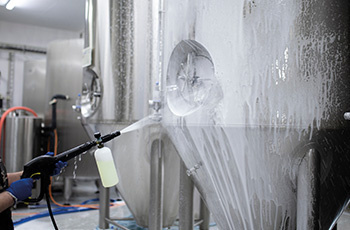
The best water pumps for tank cleaning
The internal cleaning of tanks, cisterns and industrial containers is a critical operation across a great many manufacturing sectors: from the chemical and food industries through to logistics and transport. This page looks at why carrying it out effectively calls for a high-pressure water pump, what characteristics that pump must have and which Hawk solutions are the most suitable. We will examine the pressure best suited to the different types of residue, dedicate a specific focus to cleaning IBC containers and compare the recommended Hawk series, with an in-depth look at the NMT series, the company's flagship model for 200 bar.
Why tank cleaning requires high-pressure pumps
Inside a tank or cistern, hard-to-remove residues build up: scale, solid deposits, resins, adhesives, water-resistant paints and coatings, as well as residues from food or chemical products. A high-pressure water jet makes it possible to attack and lift these substances off the internal walls quickly and evenly, reaching even the corners and the least accessible areas, without having to rely heavily on additives.
The heart of any high-pressure washing system is the piston pump: it is the component that generates the required pressure and keeps it constant throughout the washing cycle. When cleaning the containers used in manufacturing processes, drums, canisters, plastic or steel tanks, silos, vessels and chemical reactors, clean water alone is often not enough: liquids such as demineralised water, caustic soda, acids or solvents come into play. This is why choosing a pump is not only a matter of pressure, but also of the compatibility of the materials with the fluid used.
The features a tank-cleaning pump needs
A pump intended for tank cleaning often works intensively and in contact with fluids other than plain mains water. There are essentially four characteristics to assess before making a choice:
- - Pressure matched to the residue: the more stubborn the deposits, the higher the working pressure needs to be in order to remove them effectively.
- - Compatible materials: when demineralised water, chemical solutions or solvents are used, the head and the components in contact with the fluid must resist corrosion (for example Ecobrass or 316L stainless steel).
- - Temperature resistance: washing with hot water speeds up the dissolving of greases and residues, but requires pumps designed for high temperatures.
- - Long-term reliability: repeated cycles and continuous use call for robust components and low maintenance, so as to reduce plant downtime.
Which pumps are ideal for cleaning industrial tanks?
For cleaning industrial tanks, the choice of pump depends on the type of container, the residues present and the fluids involved. Hawk, which for over thirty years has been designing and manufacturing more than 70 models of high-pressure piston pumps and their accessories in Reggio Emilia, covers the full range of needs, from routine container washing to the most demanding operations.
For the internal washing of cisterns and tanks, the reference point is the NMT series, Hawk's flagship product, highly versatile and suited to being fitted on professional pressure washers and washing systems. When the residues are chemical in nature, or demineralised water or solvents are used, the same platform is available in versions with dedicated materials: the NMT Chemical, with an Ecobrass® head, and the NMT Stainless Steel, with a head and internal components in 316L stainless steel. Those seeking performance beyond the classic 200 bar can turn to the NPM series, a higher-performing variant of the NMT that reaches 250 bar.
What pressure is needed to clean tanks effectively?
There is no single value: the ideal pressure depends on the residue to be removed and on the material of the tank. For the routine internal washing of cisterns and containers, including the removal of food or chemical residues, often combined with the most appropriate cleaning fluid, a pump such as the NMT series represents an excellent balance between washing power, versatility and reliability.
A focus on cleaning IBC tanks
IBC containers (Intermediate Bulk Containers), the plastic or steel totes of around 1,000 litres widely used to store and transport liquids, fully belong among the containers that need internal washing before being refilled. Since the same IBC may hold different products over time, internal cleaning must be thorough in order to avoid cross-contamination from one load to the next.
For this application the NMT series is particularly suitable: the 200 bar maximum pressure ensures a vigorous washing action on the internal walls, while the availability of the Ecobrass® (NMT Chemical) and 316L stainless steel (NMT Stainless Steel) variants makes it possible to handle, safely, even chemical residues and the most aggressive washing fluids, such as demineralised water or permitted solvents. Paired with a rotating nozzle lowered inside the container, the pump distributes the jet evenly across the entire internal surface of the IBC.
The best Hawk solutions for tank cleaning
The table below summarises the Hawk series best suited to tank cleaning, with the stated maximum pressure and temperature values and the recommended use. The NMT series and its variants cover most internal-washing needs; the higher-pressure series are reserved for the most stubborn residues.
|
Series |
Maximum pressure |
Max water temperature |
Strengths for tank cleaning |
|
NMT |
200 bar |
65 °C |
Flagship model for 200 bar, versatile on professional pressure washers and washing systems |
|
NMT Chemical |
200 bar |
65 °C |
Ecobrass® head, suited to demineralised or salt water and to use with solvents |
|
NMT Stainless Steel |
200 bar |
85 °C |
Head and internal components in 316L stainless steel, for aggressive chemical agents and salt water |
|
NPM |
250 bar |
65 °C |
Higher-performing variant of the NMT, beyond the 200 bar threshold |
Which is the best pump for tank cleaning?
In short, the best pump for tank cleaning is the one that combines the correct pressure with the right material for the fluid used. For most internal-washing applications involving cisterns, tanks and IBC containers, the NMT series is Hawk's reference choice: it delivers the 200 bar needed for effective washing, is extremely versatile and is available in Ecobrass® and 316L stainless steel versions for the most aggressive residues and fluids. When deposits are particularly obstinate, you move up in pressure with the NPM or with the ultra-high-pressure series. To identify the configuration best suited to your plant and to the type of residue, the Hawk support service is always on hand to recommend the optimum solution.
Share this Article