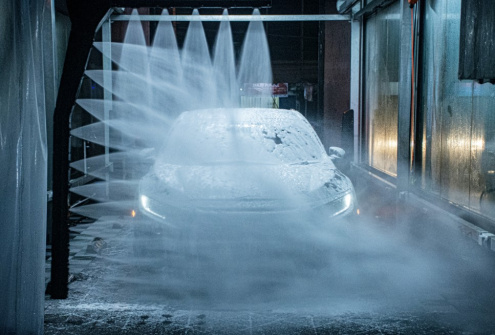
Pumps for large-scale vehicle washing systems
Industrial washing systems represent one of the most demanding applications for high-pressure pumps. Cleaning a train, a coach or an earthmoving machine has nothing in common with traditional car washing: very high flow rates, constant pressures over prolonged work shifts and components capable of withstanding continuous use are required. This guide is designed to support designers, maintenance technicians and plant managers in choosing the most suitable pump, starting from the fundamental technical characteristics, moving through the comparison between the different product families and arriving at the advantages of multi-pump systems, the benchmark solution for large-scale applications. The aim is to clearly answer the question: what are the best pumps for industrial washing?
What is meant by industrial washing
Industrial washing encompasses all cleaning operations carried out on large vehicles and equipment, where time and the quality of the result are decisive factors for productivity. It ranges from the exterior washing of trains, metros and trams to the cleaning of buses and coaches in depots, through to the cleaning of excavators, dumpers, concrete mixers and construction machinery that accumulate mud, oils and aggressive residues. These are contexts in which the quantity of water delivered and the consistency of the pressure are more important than the individual jet, because multiple operators often work in parallel or automatic ramps and arches come into operation.
The technical features that make the difference
When choosing a pump for an industrial washing system, there are three parameters to be assessed together:
- Flow rate (l/min): indicates how much water the pump is able to deliver. For washing extensive surfaces (sides of trains, buses, machinery) it is the decisive value, because it determines working speed and coverage.
- Operating pressure (bar): affects the effectiveness in removing stubborn dirt, encrustations and oily residues. In industrial systems, work typically takes place in a range starting from 150-200 bar and can exceed 500 bar in the most severe applications.
- Mechanical and thermal resistance: an industrial pump works for consecutive hours, often with water that is not always optimally filtered. High-grade materials such as stainless steel, ceramics for the pistons and forged manifolds are essential to guarantee long-term durability.
To these parameters are added others such as rotation speed, type of transmission (electric or hydraulic) and compatibility with detergents and hot water.
What are the best pumps for industrial washing?
The best pumps for industrial washing are axial piston pumps capable of combining high flow rates, stable pressures and reliability over time. Hawk produces several families of high-pressure piston pumps, each designed to cover a specific segment of applications. For washing systems for trains, coaches and heavy machinery, the most suitable series are the high-performance ones and the electric motor-pump units, which integrate pump, motor and frame into ready-to-install solutions.
The following table summarises the typical characteristics of the Hawk pump families used in industrial washing systems.
|
Pump family |
Type |
Indicative pressure range |
Typical application |
|
Standard pumps |
High-pressure axial pistons |
Up to 200-300 bar |
Vehicle washing, professional pressure washers |
|
High-performance pumps |
High-flow pistons |
High pressures with elevated flow rates |
Automatic systems, train and heavy-vehicle washing |
|
Special pumps |
Pistons for dedicated applications |
Up to over 500 bar |
Heavy industrial cleaning, hydrodemolition, high temperatures |
|
Electric motor-pump units |
Integrated pump + electric motor |
Depending on the paired pump |
Fixed multi-pump systems, washing stations |
|
Hydraulic motor-pump units |
Pump + hydraulic motor |
Depending on the paired pump |
Mobile vehicles, vehicle-mounted self-contained equipment |
The very high flow rate series of the high-performance pumps range represent the benchmark for systems that have to wash railway carriages, buses or industrial vehicles in short times, because they allow multiple nozzles, ramps and washing bars to be supplied simultaneously without performance drops.
Very high flow rate pumps for large-scale systems
In washing systems for trains and public transport vehicles, flow rate is the key parameter: very extensive surfaces must be covered in a few minutes, while the convoy or bus passes through the washing portal. In these contexts, piston pumps capable of delivering several dozen litres per minute at constant operating pressures are used, combined with high-efficiency nozzles that optimise water distribution.
Hawk's very high flow rate pumps are designed to operate continuously, with stable working torques and low noise levels even after many hours of operation. The range includes models with forged brass or stainless steel manifolds, ceramic pistons and long-life seals, all elements that reduce machine downtime and maintenance costs.
Multi-pump systems: the answer for professional washing
When a single pump unit is not enough to meet the water requirements of a system, the solution is the multi-pump system. This is a station in which two or more pumps work in parallel, managed by an electrical panel that regulates their activation according to demand. This configuration is the natural choice for:
- railway and tram depots with multiple washing tracks active simultaneously;
- bus and coach depots that carry out nightly cleaning cycles on dozens of vehicles;
- platforms for the maintenance of heavy machinery, where several operators can work with high-pressure lances during the same shift.
The advantages of multi-pump systems are tangible: redundancy in the event of maintenance on a single unit, the ability to modulate flow rate based on workload, reduction in energy consumption when only the actually necessary pumps are activated. Hawk electric motor-pump units are designed to be combined in multiple configurations, simplifying the design of dedicated washing stations.
Areas of application: from trains to construction machinery
Industrial washing covers very different sectors, but shares a common requirement: cleaning well, quickly and continuously. Among the most recurring applications of Hawk high-pressure pumps and multi-pump units are the exterior and underbody washing of trains and rolling stock, the cleaning of buses and coaches in public transport depots, the washing of excavators, loaders, dumpers and other earthmoving machinery, and the cleaning of agricultural vehicles and waste collection vehicles. In all these contexts, the pumps are used both in automatic gantry systems and in manual stations with professional lances and guns, through to centralised multi-pump stations. For a complete overview of the industrial applications covered, it is useful to consult the section dedicated to industrial cleaning.
How to choose the right model
The choice of model depends on three steps:
- Define the required flow rate and pressure based on the number of simultaneous users (lances, nozzles, ramps) and the type of dirt to be removed.
- Establish the configuration: single unit for compact systems, multi-pump system for complex installations or those requiring redundancy.
- Assess the accessories involved: nozzles, lances, guns, regulating and safety valves significantly affect the final performance of the system.
For heavy-duty applications such as the washing of heavy and industrial vehicles, the high-performance series and special pumps are often recommended, whereas for more compact systems, suitably sized standard pumps may be sufficient.
Share this Article