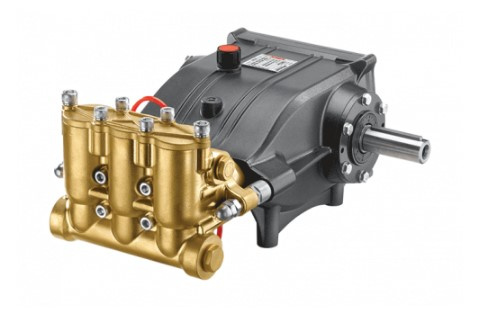
Difference between a gear pump and a piston pump
A comprehensive guide to distinguishing between gear pumps and piston pumps
When discussing positive displacement pumps, which move a fixed volume of fluid with each operating cycle, gear pumps and piston pumps are among the most widely used types. Both are designed to generate pressure and move fluids, but their operating principle, performance, and ideal applications are profoundly different. Understanding the difference between a gear pump and a piston pump is essential for engineers, technicians, and operators who need to select the most suitable component for a given system, ensuring not only process effectiveness but also the efficiency and longevity of the system.
The choice between a gear pump and a piston pump is never random, but rather the result of a detailed analysis of the application's requirements. Factors such as required pressure, fluid viscosity, flow rate, cost, and maintenance all play a decisive role. In this article, we at Hawk will take an in-depth look at how each type works and highlight their distinctive characteristics.
Gear pumps: what they are and how they work
Gear pumps are among the simplest and most robust positive displacement pumps. Their operating principle is based on the use of two gears rotating in a sealed cavity: the fluid enters through the suction port, gets trapped between the gear teeth and the housing wall, and is carried toward the discharge port. When the gear teeth mesh together again, the fluid is forced out at high pressure.
There are two main types: external gear pumps (with two identical gears meshing against each other) and internal gear pumps (a larger gear with internal teeth that drives a smaller gear). Gear pumps are valued for:
- Simplicity and robustness, since they have a relatively simple construction with few moving parts, which makes them reliable and easy to maintain;
- Uniform flow, since the fluid is moved continuously, which translates into a nearly pulsation-free flow;
- Suitability for viscous fluids, such as lubricating oils, resins, paints, and polymers. Their suction capacity is high, and internal lubrication is provided by the fluid itself.
The main limitation of gear pumps is their pressure capacity. Although there are models that reach high pressures, they are not designed for the extremely high pressures that can be achieved with piston pumps. The maximum pressure is limited by the clearance between the gears and the housing.
Piston pumps: what they are and how they work
Piston pumps, as the name suggests, use the reciprocating (alternating) motion of one or more pistons to create pressure and move the fluid. Each piston moves inside a cylinder, drawing in the fluid during the return stroke and pushing it out at high pressure during the forward stroke. The suction and discharge valves manage the flow, ensuring that the fluid moves in only one direction.
Piston pumps can have a single or multiple pistons (e.g., triplex) and are distinguished by certain specific characteristics:
- Extremely high pressure capacity: they are the preferred choice for all applications requiring very high pressures, well beyond the limits of gear pumps. They are capable of generating and sustaining pressures reaching hundreds or thousands of bar;
- Volumetric efficiency: they have high volumetric efficiency, especially at high pressures, which means that a very high percentage of the theoretically displaced fluid is actually delivered;
- Versatility: they are particularly effective with water, but there are models designed to handle a wide range of fluids;
- Precision: they are able to deliver an extremely precise volume of fluid with each cycle, making them ideal for dosing and mixing applications.
Their weak point is pulsating flow, generated by the alternating motion of the pistons. In triplex piston pumps (with 3 pistons), pulsations are significantly reduced, and a pressure accumulator is often used to stabilize the flow. Their construction is more complex, and the initial costs are generally higher.
Gear pump and piston pump: the differences
Although both fall into the category of positive displacement pumps, gear pumps and piston pumps differ clearly in operating principles, performance, and areas of use. The following table provides an at-a-glance summary of the main differences, making it easier to choose the technology best suited to specific operating conditions.
|
Characteristic |
Gear pump |
Piston pump |
|
Operating pressure |
Medium (up to ~200 bar) |
Very high (from 100 to over 1000 bar) |
|
Flow |
Continuous and steady, almost pulsation-free |
Pulsating; more uniform in triplex models |
|
Efficiency |
Good at low/medium pressures; drops at high pressures |
Very high, especially under high-pressure conditions |
|
Ideal fluids |
High-viscosity fluid (oils, resins, paints) |
Mainly water, but suitable for many other fluids |
|
Maintenance |
Reduced thanks to the simple design |
More demanding due to the complex structure |
|
Cost |
Generally more affordable |
Higher, but in line with performance and quality |
|
Typical applications |
Transfer of viscous fluids, lubrication |
High-pressure washing, hydrodemolition, precise dosing |
When to choose one or the other?
The choice between these two types of pumps depends entirely on the application's requirements. To decide correctly, you can refer to this outline, which highlights the substantial differences in terms of application:
Choose a gear pump if:
- The application requires the transfer of a high-viscosity fluid (e.g., oils, lubricants, polymers);
- The required pressure is moderate (below 200 bar);
- A constant, pulsation-free flow is needed;
- The budget is limited and you are looking for a simple, reliable solution.
Choose a piston pump if:
- The application requires high or very high pressure (above 100 bar, typically 200 bar and up);
- The fluid is low-viscosity (e.g., water);
- Energy efficiency and volumetric precision are priorities;
- The application calls for a robust, long-lasting solution with long service life;
- The goal is high-pressure washing, desalination, hydro-sandblasting, or other processes that require high hydraulic force.
In essence, gear pumps are the best choice for transferring viscous fluids at moderate pressures, while piston pumps are the ideal solution for high-pressure applications that require robustness, efficiency, and precision.
Hawk Pumps: piston pump specialists
Hawk Pumps, with its decades of experience, has chosen to specialize and excel in the design and manufacture of high-pressure piston pumps. Our piston pumps prove to be the ideal solution for those seeking a component capable of withstanding high pressures, ensuring excellent efficiency and offering exceptional durability. The use of high-quality materials and meticulous design allows us to maximize the advantages of piston pumps, offering true benchmarks for reliability in sectors such as industrial washing, water treatment, and professional cleaning.
To receive specific advice on choosing the pump best suited to your needs, contact us: our team of experts is fully at your disposal to provide all the technical support you need.
Share this Article