Pumps for parts washers
Guide to selecting pumps for parts washers
Parts washers are among the most widely used pieces of equipment in mechanical workshops, industrial maintenance departments and production lines that require thorough cleaning of mechanical components, engine parts, moulds and tooling. The heart of these machines is the pump, on which washing effectiveness, operator safety and the overall service life of the system all depend. In this guide we analyse the technical characteristics that a parts washer pump must guarantee, the specific requirements of pumps for industrial parts washing machines, the recommended working pressures for manual use, and the solutions that Hawk Pumps makes available to manufacturers and end users, with a focus on the NHDP1115 model.
What parts washers are and what they are used for
Parts washers are pieces of equipment designed for cleaning mechanical components by means of a water jet, often mixed with degreasing detergents, directed at the surface of the part to be treated. They are used on a daily basis to remove oils, greases, machining residues, metal swarf, sludge and various contaminants from components that need to be inspected, repaired, reassembled or moved on to the next production stage.
There are mainly two families of machines: those with manual operation, where the operator holds a gun or lance and directs the jet onto the part, and those with automatic operation, where the part is placed in an enclosed chamber and washed by fixed or rotating nozzles. In both cases, the pump for parts washing machines is the component that generates the pressure needed to make the mechanical action of the jet effective, and it is the first element to be carefully evaluated during the design or selection of the system.
Fundamental technical characteristics of pumps for parts washers
Selecting a pump for this type of application cannot be done without taking certain precise technical requirements into account. A pump suited to parts washing must guarantee consistent performance over many hours of work per day, withstand a fluid that often contains abrasive particles and aggressive residues, and maintain its reliability over time even under demanding operating conditions.
There are essentially four parameters to evaluate most carefully:
- Mechanical robustness and durability: the pump must withstand intensive work cycles without structural failure, with components dimensioned to guarantee a long operational life and reduced maintenance.
- Corrosion resistance: the washing water carries heavy metal residues, emulsified oils, alkaline or acidic detergents and aggressive particles that can attack the materials of the pump head; alloys and treatments specifically designed to resist this type of chemical stress are therefore required.
- Operating pressure consistent with the application: in manual parts washing machines the operating pressure is indicatively between 70 and 80 bar, values sufficient to achieve effective cleaning action while keeping the gun comfortably manageable by hand for the operator.
- Flow rate appropriate to the volume of parts to be washed: the number of litres per minute delivered determines the washing speed and must be balanced against the pressure, avoiding oversizing that would unnecessarily increase energy consumption.
The question of pressure deserves further examination. In manual parts washers, the choice to keep the maximum value within the 70–80 bar range is not arbitrary: higher pressures would produce a reaction effect on the gun sufficient to make prolonged use tiring and potentially dangerous. Applications at higher pressures, above 350 bar, belong to the different field of ultra-high-pressure industrial cleaning, where fixed lances, automated systems and hydrodemolition equipment are used.
Pumps for industrial parts washing machines: additional requirements
When moving from the small workshop parts washer to pumps for industrial parts washing machines, the requirements become more demanding. In industrial installations the pump operates for many hours a day, often continuously, with washing liquids heavily loaded with contaminants and at variable temperatures. In this context, the quality of the pump head materials, the presence of double seals with an intermediate cooling chamber, the geometry of the inlet and outlet valves, and the ability to carry out rapid maintenance interventions all become critical factors.
Reference table of operating parameters
To simplify the reading of the main parameters to consider when choosing a pump for parts washing machines, the following table summarises the typical reference values for both manual and industrial applications.
|
Parameter |
Manual parts washer |
Automatic industrial parts washer |
|
Operating pressure |
70–80 bar |
up to 150–200 bar |
|
Mode of use |
Hand-held gun |
Fixed or rotating nozzles in a cabinet |
|
Work cycles |
Intermittent |
Continuous or high-frequency |
|
Corrosion resistance |
Required |
Essential and enhanced |
|
Maintainability |
Standard |
Easily replaceable components |
The Hawk solution for parts washing machines: the NHDP1115 model
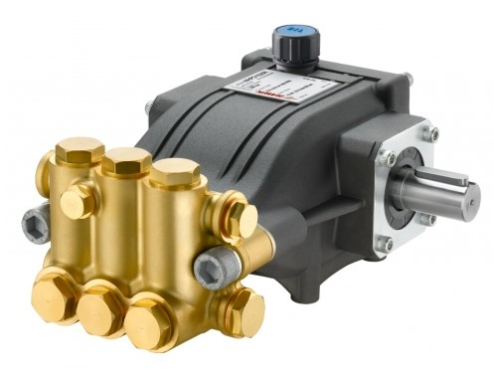
Within its range of standard piston pumps, Hawk offers a series particularly suited to manual parts washing applications: the NHDP 150 series. The NHDP 150 series is designed to operate at a maximum pressure of 150 bar and with water up to 65 °C, values that allow the typical operating conditions of manual parts washers (70–80 bar) to be handled without strain, while leaving a wide margin below the pump's sealing limit. This is important for two reasons: it ensures operation always well below the operational limit, extending the service life of the components, and it allows any pressure spikes to be absorbed without compromising the reliability of the unit.
The NHDP1115 model in particular falls within the flow rate range suited to small-to-medium parts washing machines, where the goal is an effective jet that can be comfortably managed by hand for work cycles typical of the mechanical workshop and light industrial maintenance.
Share this Article