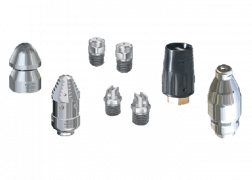
Nozzle flow rate calculation
An essential guide to understanding the relationship between pressure and flow rate and optimizing the performance of your pump and nozzles
In any high-pressure washing or spraying system, the nozzle is not just an accessory, but a key component that significantly determines the performance and efficiency of the entire system, as it is the point where all the hydraulic power generated by the pump is concentrated to generate the desired jet. If the nozzle is incorrectly sized, even the most powerful pump will not be able to work at its best, compromising the final result. For this reason, knowing how to correctly calculate the flow rate of nozzles is a fundamental skill for every professional in the sector.
The flow rate delivered by a nozzle and the pressure of the system are closely interrelated: a pump delivers a certain flow rate at a given number of revolutions, but the actual pressure is determined by the resistance that the fluid encounters at the nozzle outlet. A nozzle that is too large will cause the pressure to drop, while one that is too small will cause it to rise excessively, putting stress on the pump.
Understanding this relationship and knowing how to apply the correct formula is the first step toward optimizing the system.
Nozzle flow rate calculation: the fundamental formula
The relationship between flow rate, pressure, and nozzle is described by a formula that allows you to determine the flow rate (Q) that a specific nozzle can deliver at a given pressure (P). This formula is an indispensable tool for ensuring that the chosen nozzle is perfectly compatible with the pump's capabilities, avoiding problems of undersizing or oversizing.
The formula used to calculate the flow rate of the nozzles is as follows:
Q = nozzle number × √(P / 0.193)
Specifically, it relates three essential parameters:
- Q (flow rate): this is the quantity of fluid delivered by the nozzle per unit of time, expressed in liters per minute (l/min);
- Nozzle number: this value is a standard identifier for the nozzle. It is not a sequential integer, but a value that indicates the size of the orifice and is often linked to the flow rate that the nozzle delivers at a standard reference pressure (e.g., 70 bar). This number is stamped on the nozzle itself or provided by the manufacturer;
- P (pressure): this is the pressure of the fluid at the nozzle inlet, expressed in bar.
The coefficient 0.193 is a conversion factor that is applied when using specific units of measurement (flow rate in l/min and pressure in bar) and takes into account the properties of the fluid (water) and the standard geometry of the nozzles, greatly simplifying the calculation for professionals in the sector.
The importance of correct nozzle sizing
The correct selection of the nozzle is essential for the health and efficiency of a pump. Using an unsuitable model can cause significant problems: if the nozzle is oversized for the pump flow rate, the system pressure will drop dramatically, as the jet will be weak and inefficient for the application and the pump will operate under low pressure and high flow conditions, which can be inefficient and suboptimal; if, on the other hand, the nozzle is undersized for the pump flow rate, the pressure in the system will increase disproportionately and this can push the pump beyond its maximum pressure limits, stressing the internal components, putting seals, valves, and pipes at risk, and increasing the risk of breakdowns and accidents.
The calculation of the nozzle flow rate serves precisely to find the perfect balance between the flow rate supplied by the pump and the pressure generated by the nozzle. A well-sized nozzle ensures that the pump operates within its ideal operating range, providing the pressure and flow rate required by the application with maximum efficiency and minimum stress on the entire system.
Furthermore, the nozzle number does not only refer to the flow rate, but is also related to the spray angle, another factor that affects the effectiveness of washing or spraying. The combination of flow rate, pressure, and spray angle determines the “work” that the spray can do and its effectiveness in a specific application.
Hawk Pumps and nozzle flow rate calculation
Hawk Pumps, a company specializing in the manufacture of piston pumps and high-pressure nozzles, recognizes the fundamental importance of pairing a quality pump with the right nozzle. Our pumps are designed to deliver exceptional performance and reliability over time.
Knowing how to calculate nozzle flow rate is an essential step in ensuring that your pump operates under optimal conditions, delivering maximum pressure and flow rate without the risk of overload or inefficiency. Our mission is not only to provide you with high-quality pumps, but also to support you with the knowledge you need to optimize your entire high-pressure system.
If you have any questions or need assistance in choosing the most suitable pump and nozzle for your application, please do not hesitate to contact us: our team of experts is at your complete disposal to provide technical advice, helping you make the best choice for the efficiency and safety of your system.
Share this Article